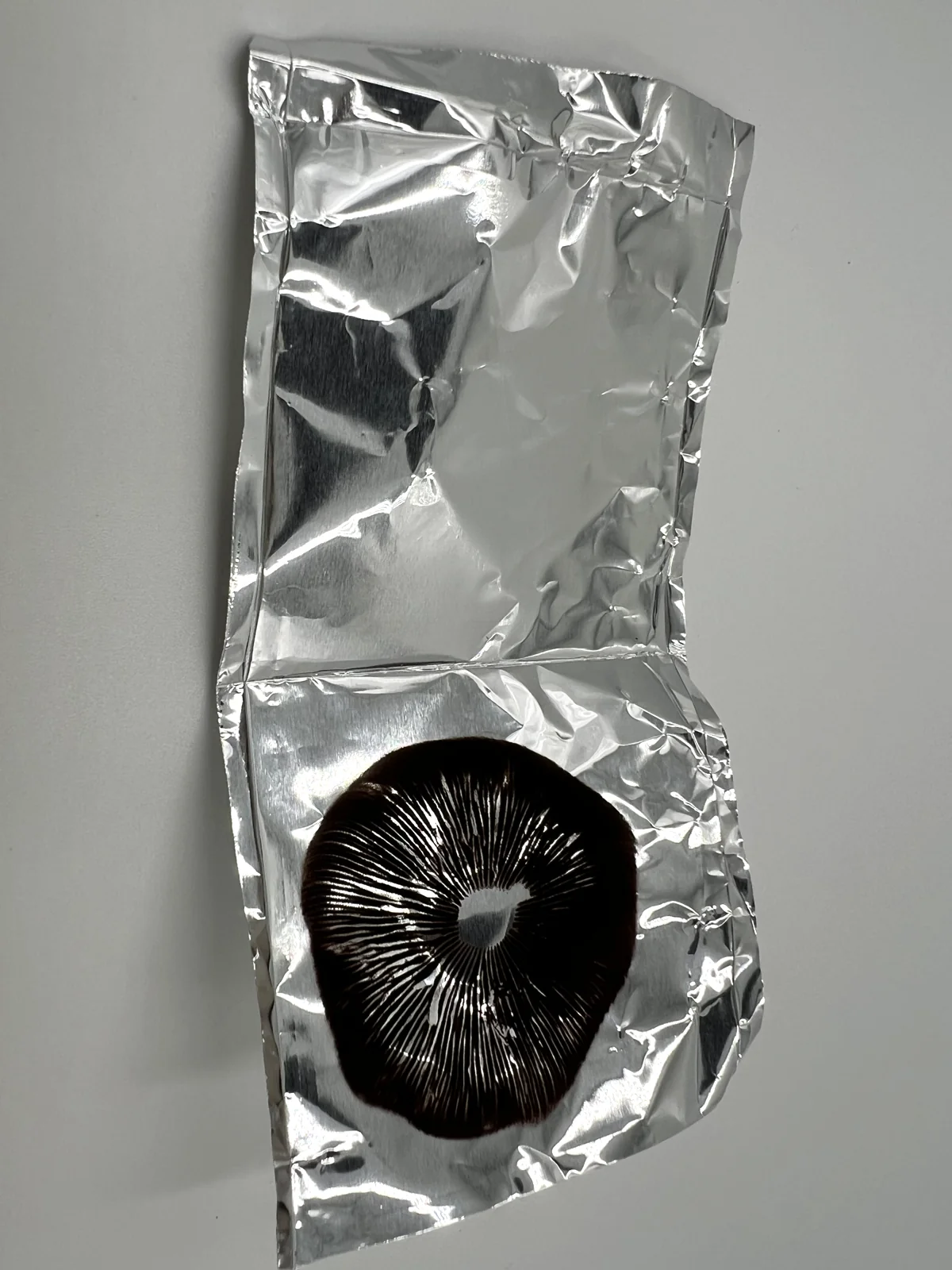
Entheogen Explosion Spore PrintPsilocybe cubensis, prepared in the UK for microscopy
£25.99
In stock. Order and pay before 2pm, Monday to Friday, for same-day dispatch.
Free delivery from £35, then up to 20% off.
- £35Free delivery
- £555% off
- £79.9910% off
- £15015% off
- £30020% off
Also available as an Entheogen Explosion spore syringe — from £6.99
About Entheogen Explosion
Entheogen Explosion spore print is the dry spore deposit of a Psilocybe cubensis line whose history is not recorded, dropped by a cap onto sterile foil in still air and sealed in its own bag.
What you get
One Entheogen Explosion print on sterile foil, folded and sealed in a bag of its own. The cap stood over the foil in still air until it had dropped its spores, and the deposit went into the bag undisturbed. Opened, it shows a dark purple-brown deposit in mass, and the heaviness of the print is plain to the eye. Entheogen Explosion is a line whose history is not recorded; the name points to the spores and how they gather, not to a place.
Using the print
Unfold the foil on a clean bench. Scrape a trace of the deposit into a drop of sterile water on a slide with a sterile loop, cover it and let it settle. This is a line whose spores tend to lie in dense clusters on the slide, so use a smaller scrape than you think you need and tease it well into the water, or the field will be crowded. For a stock you can draw from, stir a scrape into a syringe of sterile water.
Keeping it
Store the print sealed, dry and away from light and it will keep for years. The fridge is fine and so is a drawer at room temperature; the print does not mind which, as long as the bag stays closed. Open it only to take a scrape and seal it again at once. Because this deposit is a heavy one, handle the foil gently so that spores are not shaken loose into the bag. Keep the foil flat so the deposit stays in one piece.
Key features
- Dark, heavy deposit that gathers in clusters, shown in mass on the foil
- Dropped onto sterile foil in still air
- Keeps for years dry, dark and sealed
Technical specifications
- Species
- Psilocybe cubensis
- Form
- Spore print on sterile foil, sealed in its own bag
- Lineage
- A line whose history is not recorded
- Spore print
- Dark purple-brown in mass; spores ellipsoid, 11 to 14 by 7 to 9 µm, thick-walled, with a germ pore
- Family
- Classic strains
Microscopy characteristics
In mass the deposit is dark purple-brown, and on the slide the spores of this line tend to lie in clusters. Each is ellipsoid, 11 to 14 by 7 to 9 µm, thick-walled, with a germ pore. The clustering is the print's habit; the spore is the species'.
Under the electron microscope
- Magnification
- 12.09 K ×
- Scale bar
- 10 µm
- Instrument
- Zeiss scanning electron microscope, gold-coated sample
- EHT
- 4.00 kV
- Working distance
- 6.8 mm
- Detector
- SE2
A micrograph of this strain's own spores. Spore shape and surface are what you are looking at down the microscope, so a frame of the spores is the reference to compare a slide against.
Studying more than one strain?
Delivery is free from £35, and the discount rises with the basket — 5% from £55, up to 20% from £300. Applied automatically at checkout.
Compare with related strains
Entheogen Explosion FAQs
Print or syringe?
For Entheogen Explosion the print is the better way to see the trait it is named for, since the clustering and the weight of the deposit are visible on the foil before a slide is made. The syringe suits anyone who wants a drop ready to go.
Why do the spores clump on my slide?
That is the line's habit, and it is what the name refers to. Use a smaller scrape and stir it well into the drop of sterile water, and the clusters open out enough to study single spores.
Customer reviews
No reviews yet. Reviews are written by customers from the link in their dispatch email, so every one comes from a confirmed order.